
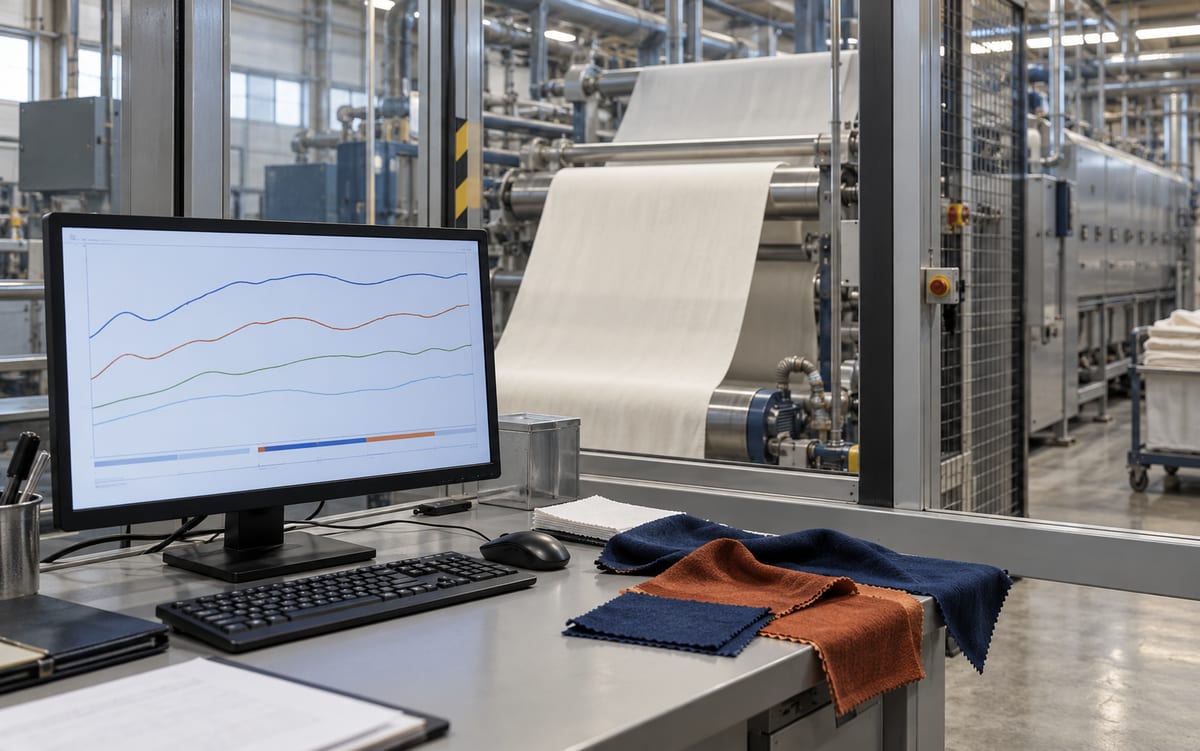
 AI示意图
AI示意图AI示意图,非新闻现场或商品实拍。
The most expensive cost in textile dyeing is rarely on the normal production line. It hides in the loop of trial, rework, and trial again. Heat-setting alone consumes over 45% of total energy in dyeing operations, yet first-pass success sits at roughly 70%. Put those two figures together and nearly a third of capacity is being burned on ineffective output. That is the most direct commercial case for AI in dyeing: not spectacle, but the elimination of hidden cost.
The Energy Hog and AI's Entry Point
Traditional heat-setting machines work on a simple logic. Operators set temperature, speed and overfeed based on fabric type and process sheets, and the machine runs at those fixed values. But inside the drying chamber, moisture content, width and weft density are all changing dynamically. Fixed parameters cannot match those shifts. Hongda Intelligent Technology's approach uses machine vision to capture weight, weft density, skew and moisture in real time, then adjusts process parameters through algorithms, forming a closed loop of sensing, decision, execution and optimization.
Operational data shows first-pass success improved by about 15 percentage points, with comprehensive energy savings of roughly 12%. By the end of 2025, the system had been deployed at around 500 enterprises domestically and overseas, lifting capacity by 10%, cutting energy use by 15% and raising premium-grade rates by 5%. For mills, this means squeezing more effective output from the same asset base. For buyers, it translates into better delivery reliability and batch consistency.
From Inspection to Color Matching
Fabric inspection is one of the most labor-dependent steps. The human eye can scan only 10 to 20 meters per minute, and missed defects are inevitable once fatigue sets in. Yantai Yelin Textile invested 500 million yuan to build a fully digital, green smart factory for knit dyeing. Its AI visual inspection system covers more than 30 defect types, with a comprehensive detection rate above 90% and precision down to 0.05mm. Its AI super agent also boosts efficiency by over 50% in production management, procurement compliance and knowledge transfer.
Zhejiang Meixinda Textile Dyeing's AI visual inspection reaches 99.5% accuracy, and over 99% when paired with automatic cutting equipment. More critically, its AI color library and fabric digital twin allow the system to scan a color and generate a recipe in 30 seconds, with first-pass dyeing qualification above 95%. Vice General Manager Jin Yicheng once noted that master dyers used to adjust color by eye, and when the shade was off, they re-dyed, doubling energy consumption with each correction. AI reduces the number of corrections, and the energy ledger improves accordingly.
Organization and Sustainability
Xurong Group, with over 50 years of history, appointed a Chief AI Officer in 2025 on its 50th anniversary, becoming the first textile company to create such a role. Executive Director Huang Guanhua believes AI's value lies not only in technology but in communication, coordination and human-machine collaboration. Take the sample production sheet, a cross-departmental pain point. Because clients use inconsistent terminology, new staff need six months to a year to learn it, and even veterans take about two hours to translate. With an AI agent, that drops to roughly 20 minutes. Xurong has deployed over 80 AI agents, saving thousands of work hours weekly.
Meixinda General Manager Long Fangsheng proposes a three-stage framework: shaping, soul-casting and intelligence-enabling. Shaping restructures the factory form. Soul-casting builds data culture and connects logistics, process and energy chains. Intelligence-enabling cultivates a proprietary decision-making brain. Its integrated computing platform links PLM, MES, ERP, SCM, WMS and carbon management systems, spawning five agents for procurement, scheduling, production, sales and trend forecasting. Yelin's automated dye and chemical dispensing achieves ±0.5% precision, cutting chemical use by 12% and labor costs by 60%. Its digital twin factory reduces unplanned downtime by 40%.
Wensli Group's waterless printing and dyeing machine uses AI to precisely control dye dosage, reducing wastewater discharge by 99%, saving 40% to 50% energy and cutting dye use by 20% to 30%. These figures point to one conclusion: the competitiveness benchmark in dyeing is shifting from equipment age to data density.