
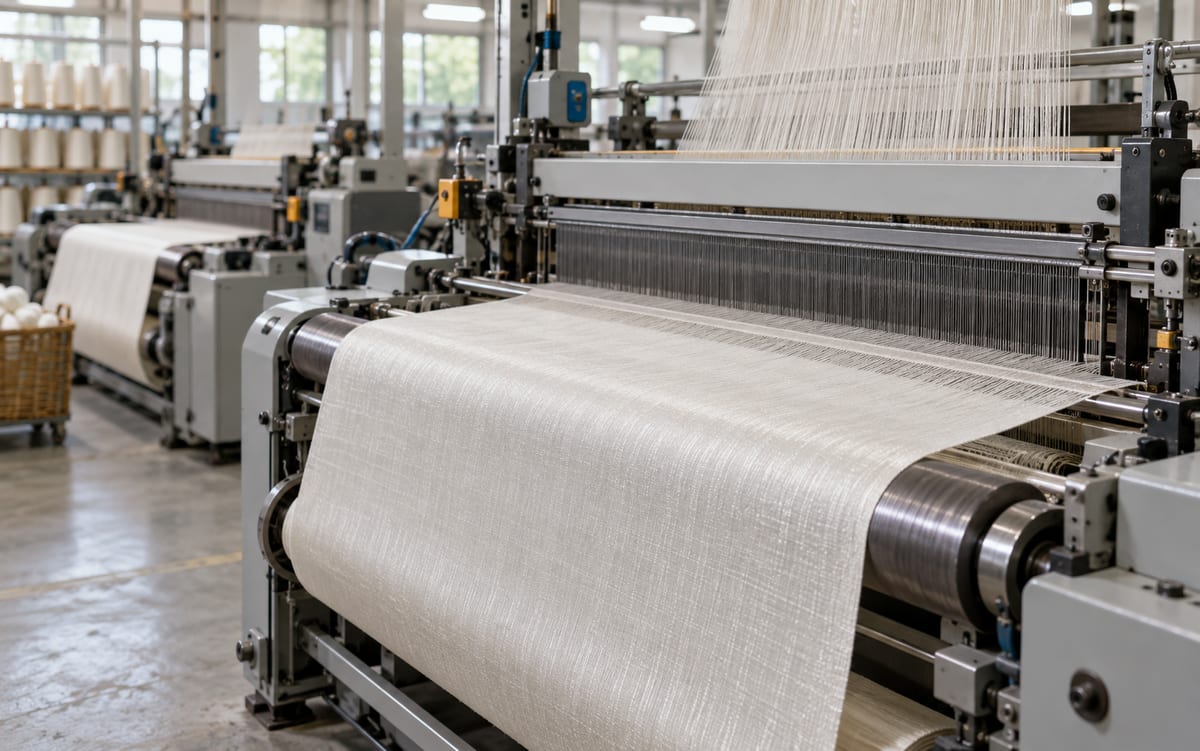
 AI示意图
AI示意图AI示意图,非新闻现场或商品实拍。
The geography of silk production capacity is being rewritten. Jiaxin Silk's Guangxi subsidiary has completed commissioning and started trial production with 12 rapier looms at its new Yizhou base. The industry significance lies not in the number of machines but in the fact that a veteran Yangtze Delta silk enterprise has actually moved weaving operations into the cocoon-producing region. Over the past decade, western expansion mostly stayed at the front end—cocoon purchasing and reeling—while weaving and new materials R&D remained in the east. This trial run suggests that division of labor is beginning to loosen.
From Raw Material to Weaving
Since entering Yizhou in 2016, Jiaxin Silk has established a silk industrial park and gradually embedded itself into the local cocoon and silk system. After a decade of accumulation, its western footprint now extends from raw material supply to high-end weaving and new materials R&D. The initial 12 rapier looms represent limited scale, but rapier looms are suited for multi-variety, small-batch, high-value fabrics. The trial direction points to high-end fabrics and silk-based new materials, not mass-produced greige silk.
The industrial logic: Guangxi offers location cost advantages in cocoon silk raw materials but has long lacked high-end weaving capability, with much of the fabric value-added captured in eastern finishing stages. Placing rapier looms in Yizhou effectively connects high-value manufacturing directly at the raw material end, shortening the physical link from cocoon to fabric. For upstream cocoon farmers and reeling mills, this means stronger local absorption capacity; for downstream buyers, a new western sourcing option emerges.
The Real Meaning of Two-Way Empowerment
The new base promotes a "smart manufacturing plus service" dual-drive model and emphasizes two-way empowerment between Zhejiang and Guangxi industrial chains. The mechanism: new processes and fabric ideas from Jiaxing R&D are quickly tested and scaled in Yizhou, while operational experience and process optimization from the production side flow back to R&D. If this works, it essentially grafts eastern R&D density onto western manufacturing costs.
But two-way empowerment is not automatic. Cross-regional management, unified process standards, technician training, and supply chain responsiveness are real constraints. Rapier looms demand high operator skill and process coordination. Whether Yizhou can form a stable technical team will directly determine whether trial production transitions smoothly to volume. Opening advanced weaving processes and mass production experience to upgrade the western silk industry also requires stable expectations on orders, quality, and delivery among upstream and downstream firms, or collaboration remains rhetorical.
Transmission to Supply Chain Dynamics
From an industry perspective, this is a concrete case of consolidating the "east-to-west mulberry transfer" and implementing the "east silk, west consolidation" strategy. For years, regional transfer in the cocoon silk industry focused on mulberry planting and silkworm rearing, while weaving and deep processing stayed east. If more eastern silk firms follow with weaving capacity in Guangxi, China's silk-based fabric supply map will gradually shift from unipolar to multipolar. For buyers, short-term impact is limited, but mid-term attention should go to quality stability and delivery capability of western lines; for eastern factories, order diversion pressure in mid-to-high-end segments is accumulating.
New materials deserve attention. Silk-based new material applications are expanding from traditional apparel to home textiles, medical, and beauty sectors. Whoever masters coordination between raw material and weaving ends will more easily build barriers in the new materials race. Keeping R&D in Jiaxing and trial weaving in Yizhou is essentially trading geographic division of labor for a balance between innovation speed and cost flexibility.